



Tag Archives: WholeBodyVibrationTraining
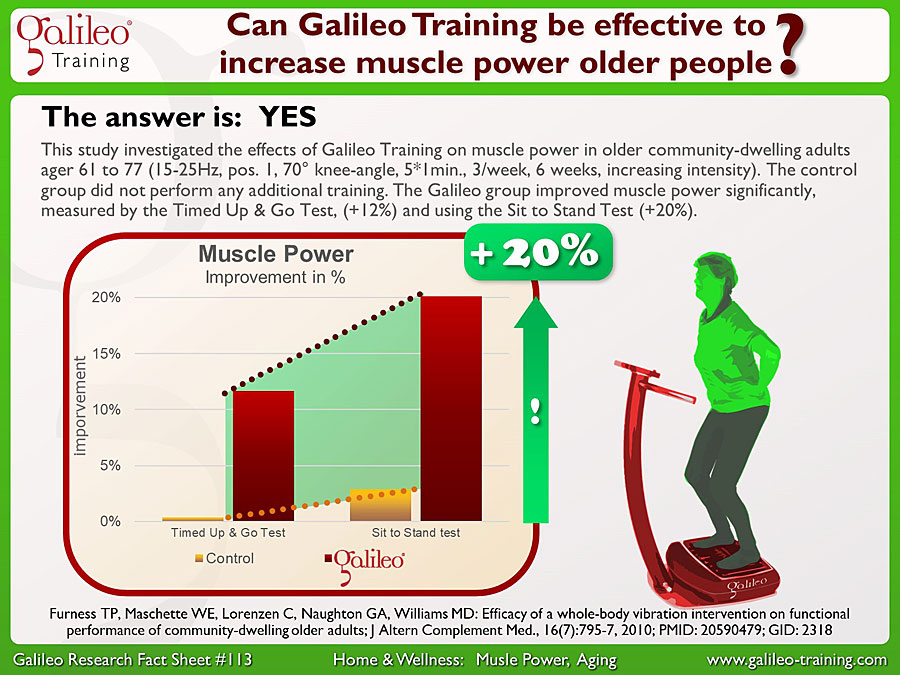
Galileo Research Facts No. 113: Can Galileo Training be effective to increase muscle power older people?
This study investigated the effects of Galileo Training on muscle power in older community-dwelling adults ager 61 to 77 (15-25Hz, pos. 1, 70° knee-angle, 5*1min., 3/week, 6 weeks, increasing intensity). The control group did not perform any additional training. The Galileo group improved muscle power significantly, measured by the Timed Up & Go Test, (+12%) and using the Sit to Stand Test (+20%)...

Galileo Research Facts No. 111 Does muscle activation during Galileo Training increase with amplitude?
This study tested muscle activation (EMG) of different muscles of the leg at different amplitudes and frequen-cies (5..30Hz) (pos. 2.5 vs. pos. 5, slightly flexed legs). It showed that higher amplitudes (pos. 5) can increase muscle activation by up to 2.75 times compared to low amplitudes (pos. 2.5). Therefore the amplitude is an easy way to adjust the intensity of Galileo Training. (On Galileo the position is equivalent to amplitude in mm)...
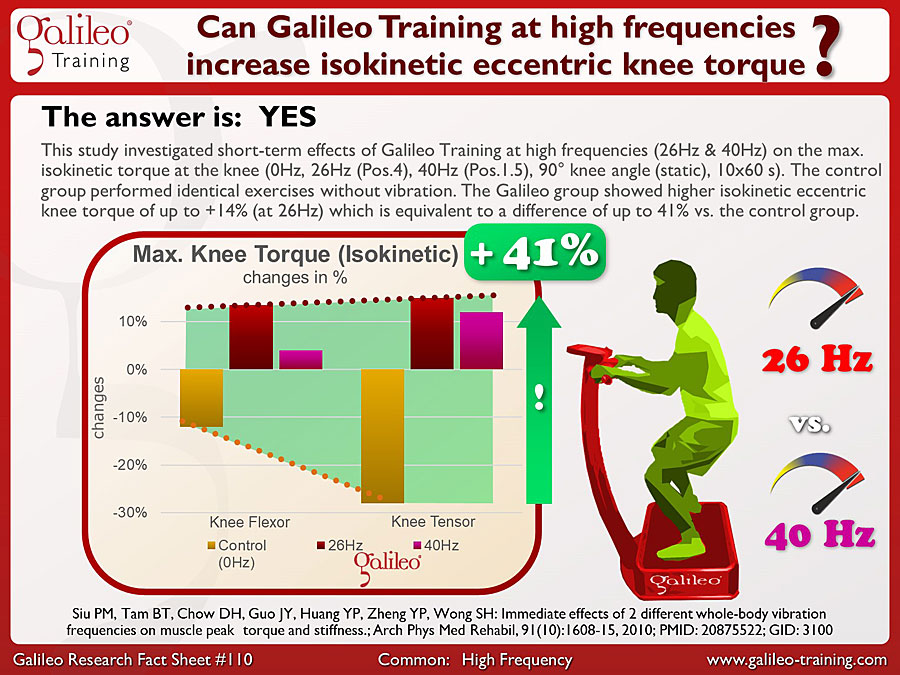
Galileo Research Facts No. 110: Can Galileo Training at high frequencies increase isokinetic eccentric knee torque?
This study investigated short-term effects of Galileo Training at high frequencies (26Hz & 40Hz) on the max. isokinetic torque at the knee (0Hz, 26Hz (Pos.4), 40Hz (Pos.1.5), 90° knee angle (static), 10x60 s). The control group performed identical exercises without vibration. The Galileo group showed higher isokinetic eccentric knee torque of up to +14% (at 26Hz) which is equivalent to a difference of up to 41% vs. the control group...
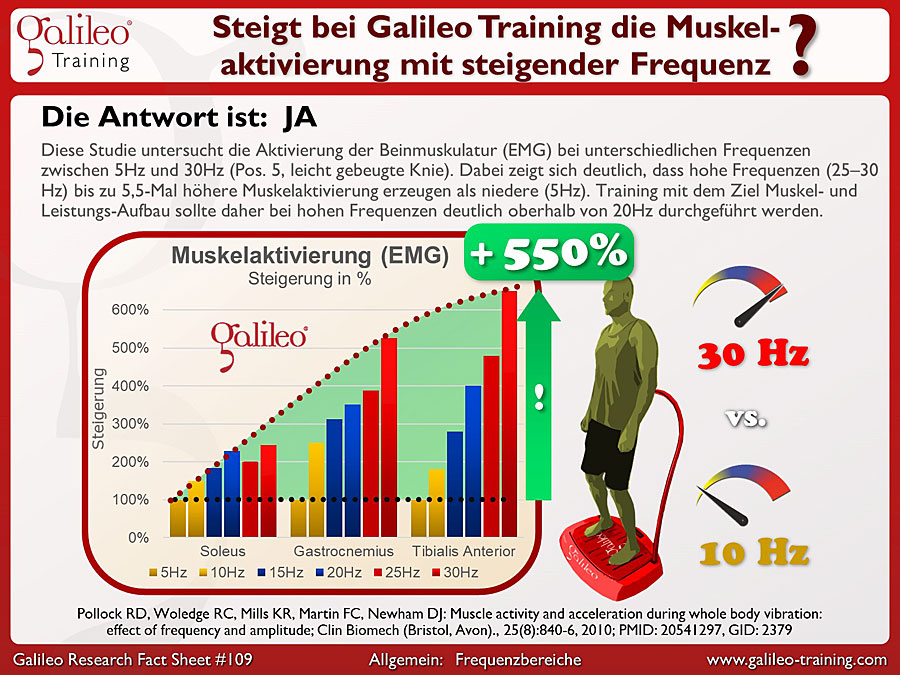
Galileo Research Facts No. 109: Can high frequencies increase muscle activation during Galileo Training?
This study tested muscle activation (EMG) of different muscles of the leg at different frequencies between 5 and 30Hz (pos. 5, slightly flexed legs). It showed that high frequencies (25-30Hz) can increase muscle activation by up to 5.5 times compared to low frequencies at 5Hz. Therefore Galileo Training targeting muscle hypertrophy and muscle power should be using high frequencies above 20 Hz to increase muscle activation...
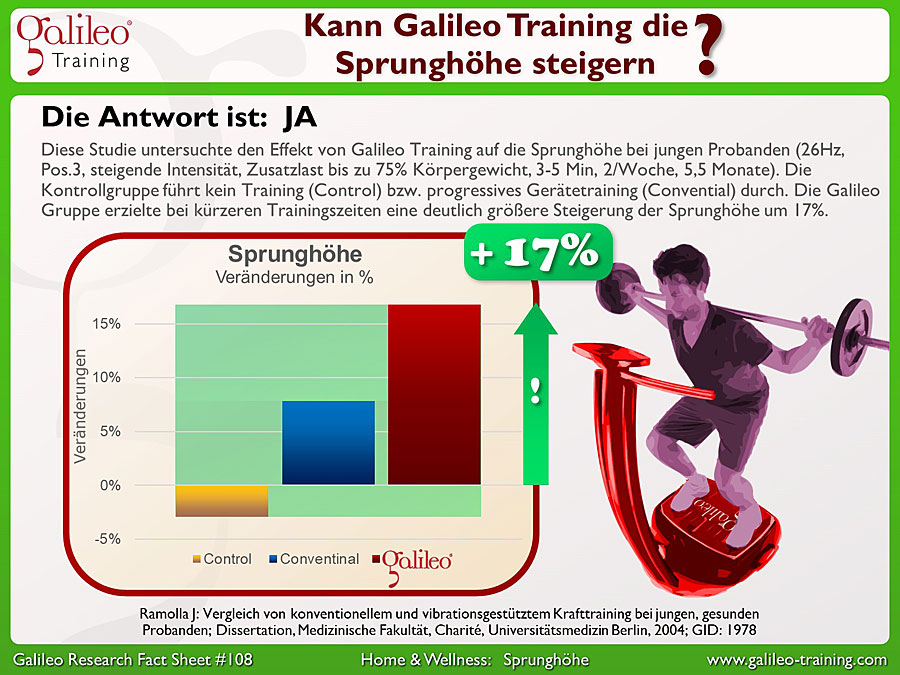
Galileo Research Facts No. 108: Can Galileo Training improve jump height?
This study documented the effects of Galileo Training on jump height in young individuals (26Hz, pos.3, increasing intensity, extra loading up to 75% body weight, 3-5 min, 2/week, 5.5 months). The control groups received no training (control) or conventional strength-training (conventional). Even though the Galileo group had the shorter training session it showed significantly higher results with up to 17% increase of jump height...

Galileo Research Facts No. 101: Does Galileo Training trigger a stretch-reflex with each upwards movement of the platform?
This study proved that Galileo Training triggers a stretch reflex with each upwards movement of the platform. It also proved that the EMG signal corresponding to the vibration frequency is not a motion artifact but an actual activation of the corresponding muscle. The measured latency is therefore not dependent on the vibration frequency but on the individual and is identical with the latency caused by one single tilt movement...
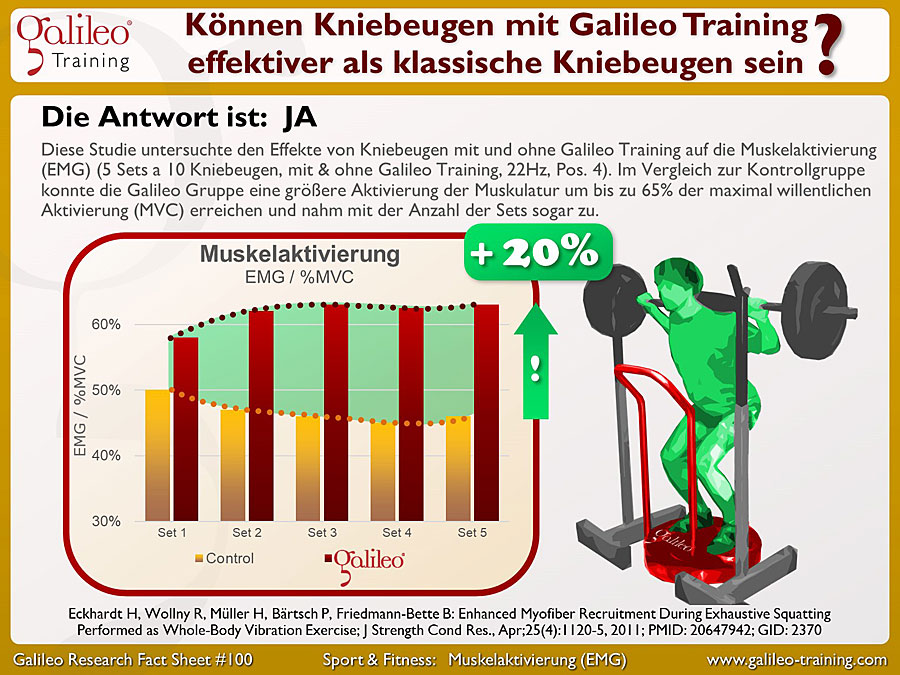
Galileo Research Facts No. 100: Can squats in combination with Galileo Training be even more effective?
This study investigated the effects of squats with and without Galileo Training on muscle activation (EMG) (5 Sets of 10 squats, with & without Galileo Training, 22Hz, pos. 4). Compared to the control group the Galileo Group was able to increase muscle activation more (by up to 65% of maximum voluntary contraction, MVC) and could even increase the activation from set to set...
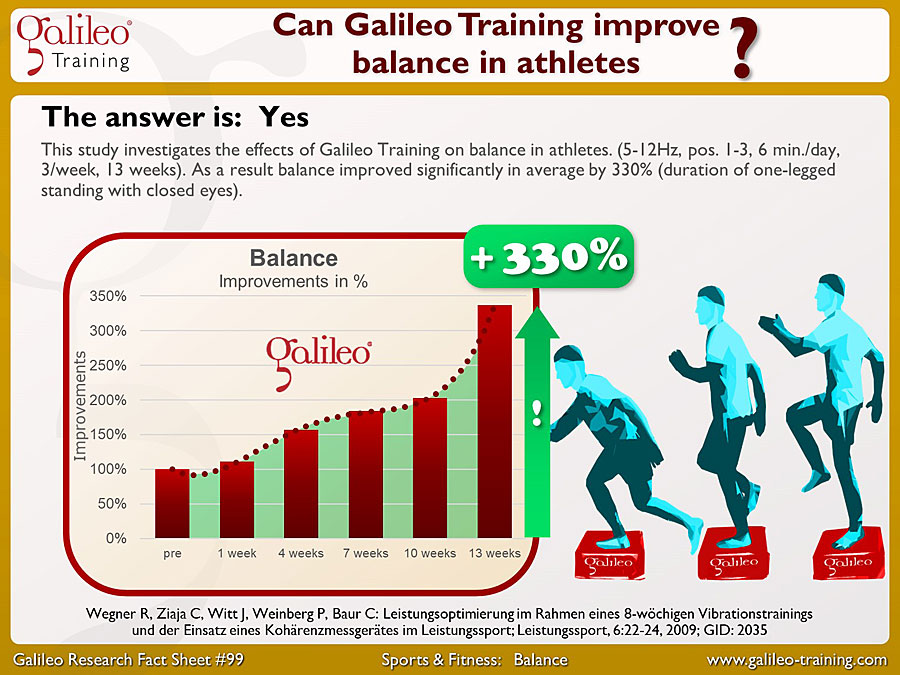
Galileo Research Facts No. 99: Can Galileo Training improve balance in athletes?
This study investigates the effects of Galileo Training on balance in athletes. (5-12Hz, pos. 1-3, 6 min./day, 3/week, 13 weeks). As a result balance improved significantly in average by 330% (duration of one-legged standing with closed eyes)...
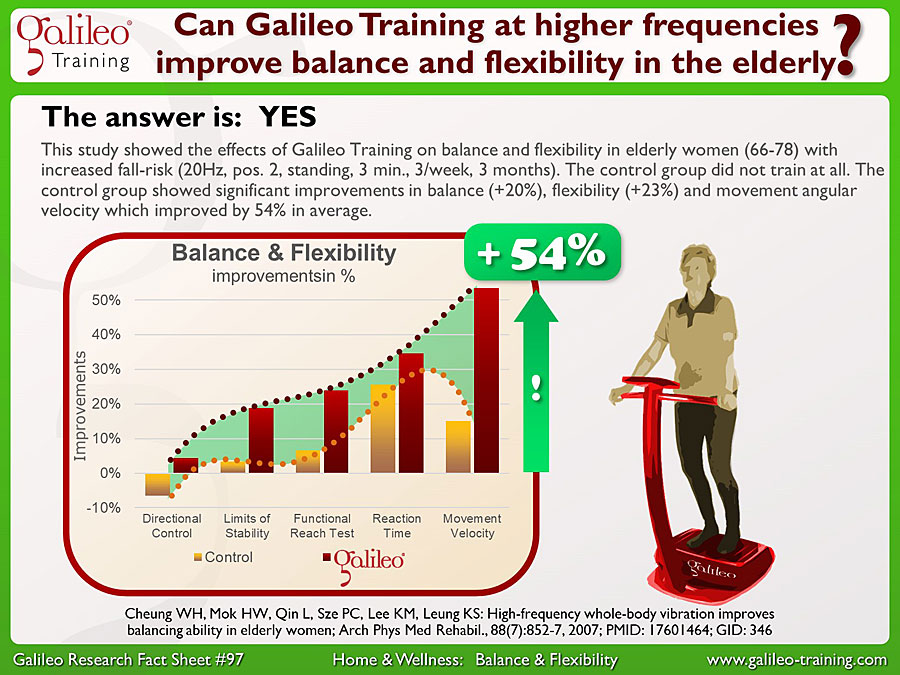
Galileo Research Facts No. 97: Can Galileo Training at higher frequencies improve balance and flexibility in the elderly?
This study showed the effects of Galileo Training on balance and flexibility in elderly women (66-78) with increased fall-risk (20Hz, pos. 2, standing, 3 min., 3/week, 3 months). The control group did not train at all. The control group showed significant improvements in balance (+20%), flexibility (+23%) and movement angular velocity which improved by 54% in average...
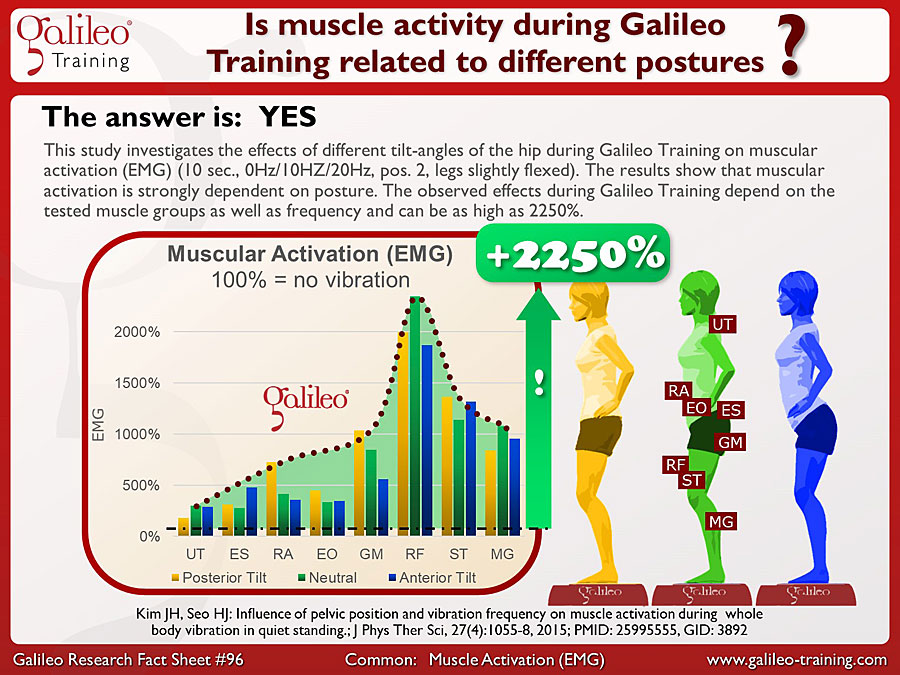
Galileo Research Facts No. 96: Is muscle activity during Galileo Training related to different postures?
This study investigates the effects of different tilt-angles of the hip during Galileo Training on muscular activation (EMG) (10 sec., 0Hz/10HZ/20Hz, pos. 2, legs slightly flexed). The results show that muscular activation is strongly dependent on posture. The observed effects during Galileo Training depend on the tested muscle groups as well as frequency and can be as high as 2250%...