


Tag Archives: GalileoTraining
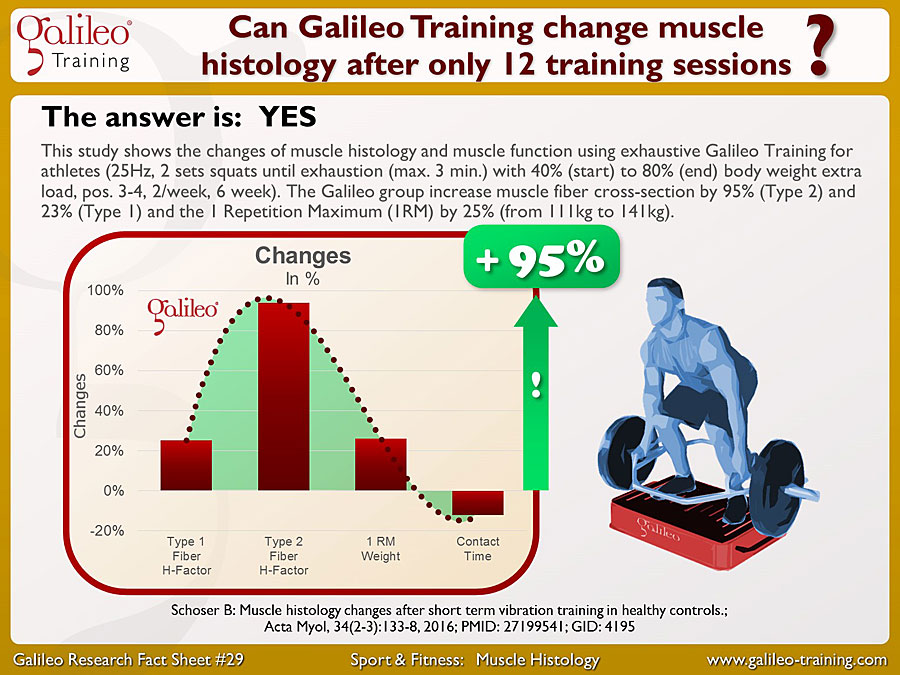
Galileo Research Facts No. 29: Can Galileo Training change muscle histology after only 12 training sessions?
This study shows the changes of muscle histology and muscle function using exhaustive Galileo Training for athletes (25Hz, 2 sets squats until exhaustion (max. 3 min.) with 40% (start) to 80% (end) body weight extra load, pos. 3-4, 2/week, 6 week). The Galileo group increase muscle fiber cross-section by 95% (Type 2) and 23% (Type 1) and the 1 Repetition Maximum (1RM) by 25% (from 111kg to 141kg)...
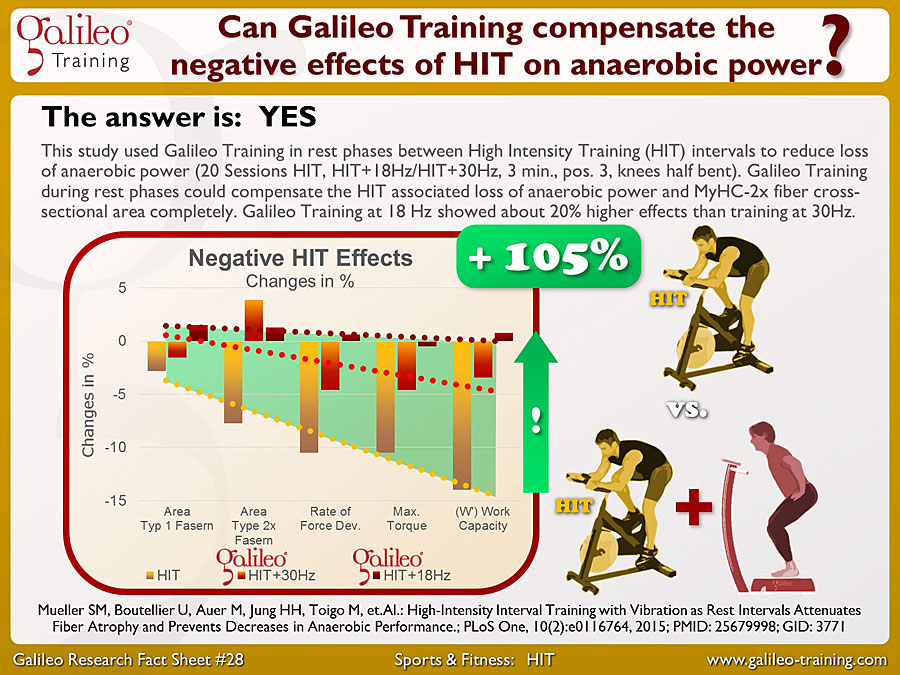
Galileo Research Facts No. 28: Can Galileo Training compensate the negative effects of HIT on anaerobic power?
This study used Galileo Training in rest phases between High Intensity Training (HIT) intervals to reduce loss of anaerobic power (20 Sessions HIT, HIT+18Hz/HIT+30Hz, 3 min., pos. 3, knees half bent). Galileo Training during rest phases could compensate the HIT associated loss of anaerobic power and MyHC-2x fiber cross-sectional area completely. Galileo Training at 18 Hz showed about 20% higher effects than training at 30Hz...
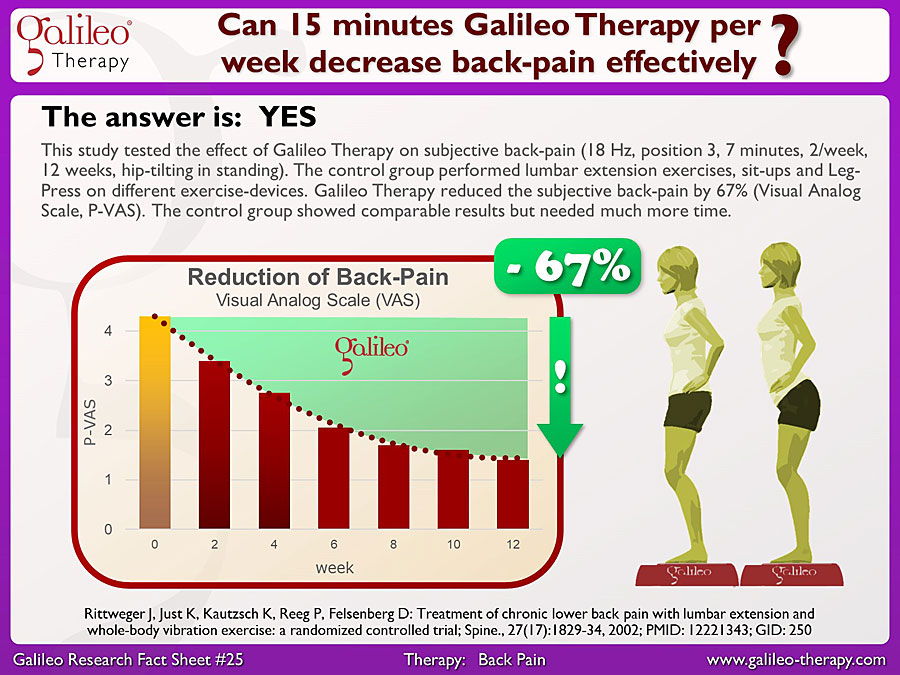
Galileo Research Facts No. 25: Can 15 minutes Galileo Therapy per week decrease back-pain effectively?
This study tested the effect of Galileo Therapy on subjective back-pain (18 Hz, position 3, 7 minutes, 2/week, 12 weeks, hip-tilting in standing). The control group performed lumbar extension exercises, sit-ups and Leg-Press on different exercise-devices. Galileo Therapy reduced the subjective back-pain by 67% (Visual Analog Scale, P-VAS). The control group showed comparable results but needed much more time.

Galileo Research Facts No. 23: Is oxygen uptake during Galileo Training independent from frequency and amplitude?
This study reports the influence of frequency and amplitude during Galileo Training on the oxygen uptake (1 min., 18-34Hz, position 1.5 to 3.5, active standing at 170°). The results show that with increasing frequency and amplitude oxygen consumption during Galileo Training can be increased up to 170%. The effect of higher increasing frequencies dominated the effect of increasing amplitude...

Galileo Research Facts No. 22: Does oxygen uptake during Galileo Training increase with frequency and extra loading?
This study tested the influence of frequency and extra loading during Galileo Training on the oxygen uptake (1 min., 18Hz and 34Hz, position 2.5, active standing at 170°, extra loading 40% of lean body mass). The results show that with increasing frequency and increasing extra loading Galileo Training can increase oxygen uptake by up to 260%.

Galileo Research Facts No. 21: Does blood-flow during Galileo Training increase with frequency and Amplitude?
This study reports the influence of frequency and amplitude during Galileo Training on the blood-flow (1 min., 5-30Hz, position 2.5 and 4.5, static squatting). The results show that with increasing frequency and increasing amplitude blood-flow velocity during Galileo Training can be increased by 220% to 420%.
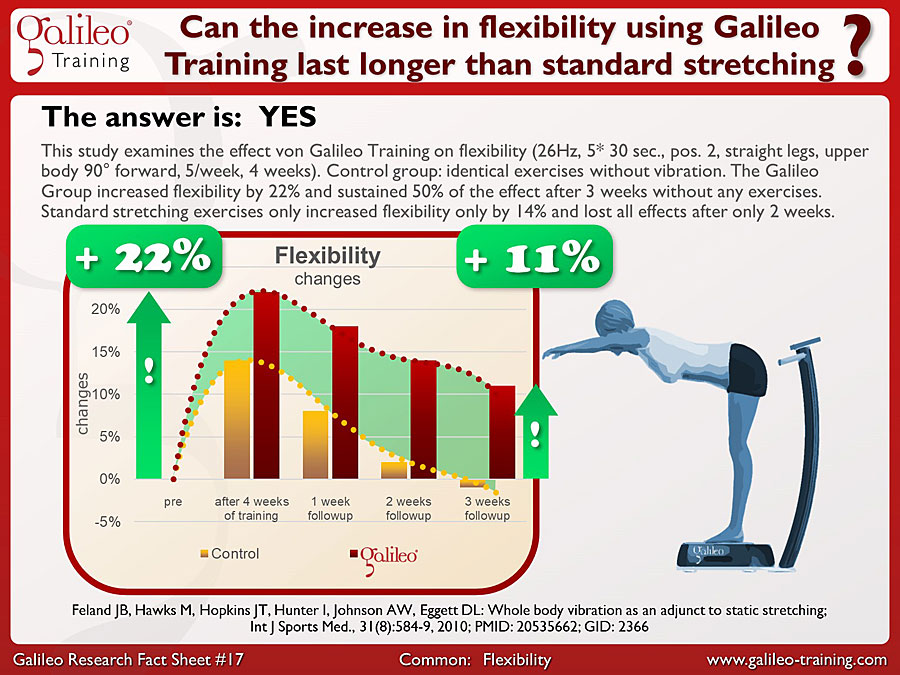
Galileo Research Facts No. 17: Can the increase in flexibility using Galileo Training last longer than standard stretching?
This study examines the effect von Galileo Training on flexibility (26Hz, 5* 30 sec., pos. 2, straight legs, upper body 90° forward, 5/week, 4 weeks). Control group: identical exercises without vibration. The Galileo Group increased flexibility by 22% and sustained 50% of the effect after 3 weeks without any exercises. Standard stretching exercises only increased flexibility only by 14% and lost all effects after only 2 weeks...
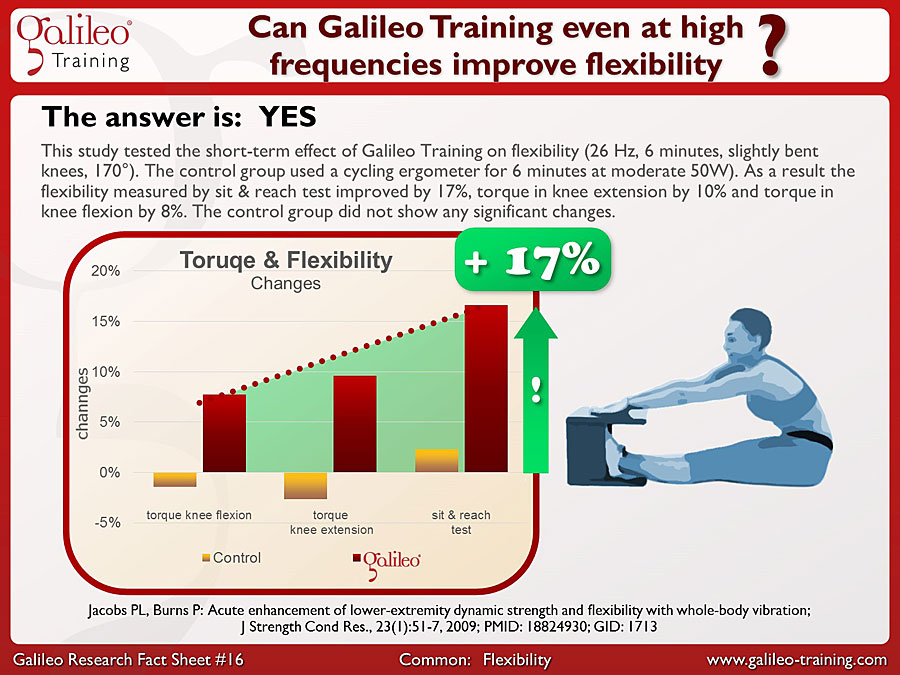
Galileo Research Facts No. 16: Can Galileo Training even at high frequencies improve flexibility?
This study tested the short-term effect of Galileo Training on flexibility (26 Hz, 6 minutes, slightly bent knees, 170°). The control group used a cycling ergometer for 6 minutes at moderate 50W). As a result the flexibility measured by sit & reach test improved by 17%, torque in knee extension by 10% and torque in knee flexion by 8%. The control group did not show any significant changes...
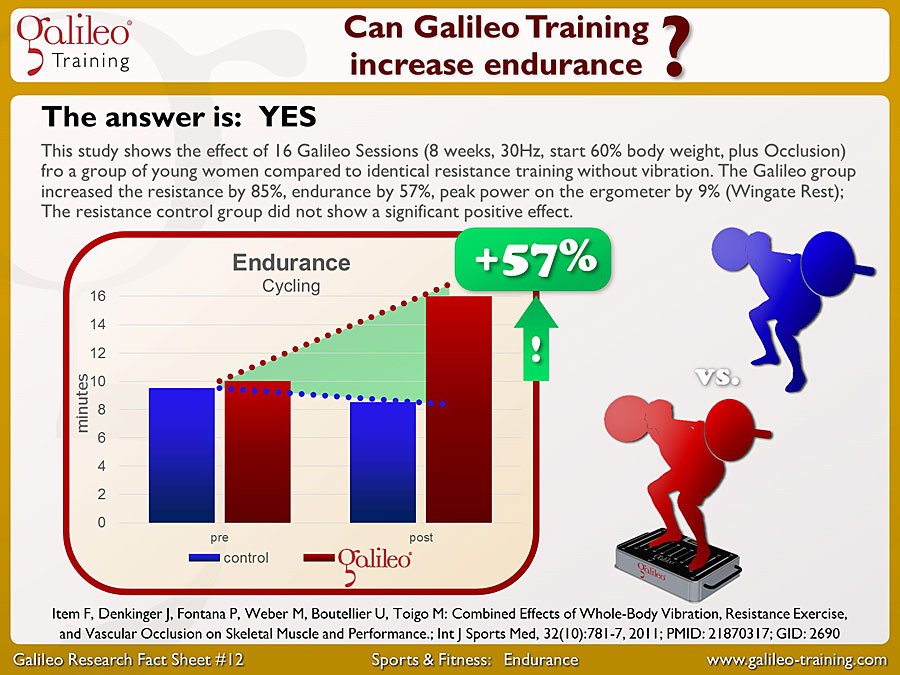
Galileo Research Facts No. 12: Can Galileo Training increase endurance?
This study shows the effect of 16 Galileo Sessions (8 weeks, 30Hz, start 60% body weight, plus Occlusion) fro a group of young women compared to identical resistance training without vibration. The Galileo group increased the resistance by 85%, endurance by 57%, peak power on the ergometer by 9% (Wingate Rest); The resistance control group did not show a significant positive effect...
Galileo Research Facts No. 11: Can endurance athletes also gain with Galileo Training?
This study shows the effect of 16 Galileo Sessions (8 weeks, 30Hz, start 70% 1RM, plus Occlusion) for cyclists and Triathletes compared to identical resistance training. The Galileo Group increased muscle mass at the thigh by 3%, type 1 fiber cross-section by 25%, type 2 fiber cross-section by 23%, capillarization by 8% with no significant effect in the resistance training control group...