


Tag Archives: GalileoSpace
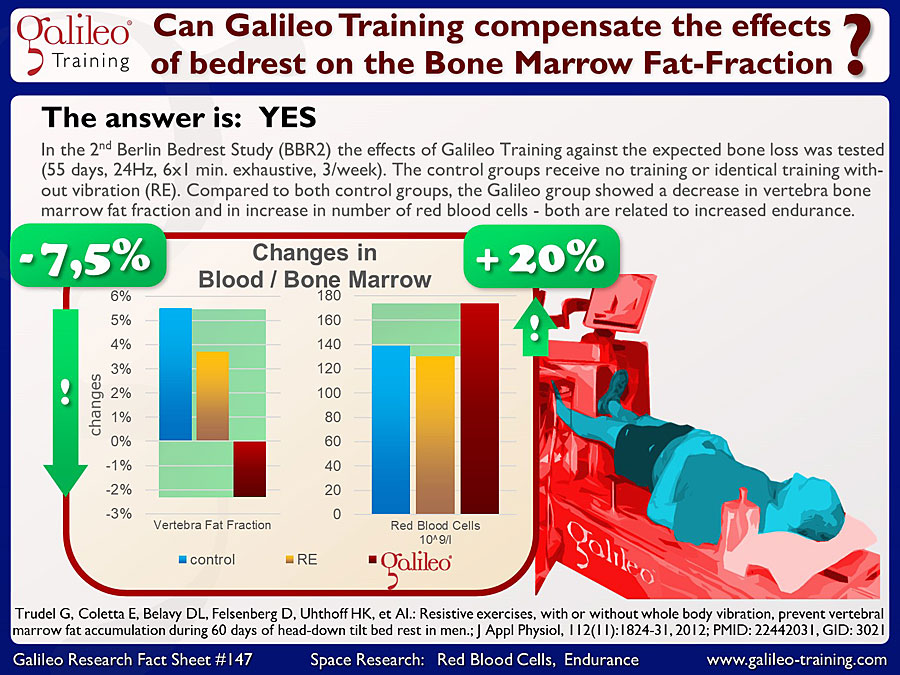
Galileo Research Facts No. 147: Can Galileo Training compensate the effects of bedrest on the Bone Marrow Fat-Fraction?
In the 2nd Berlin Bedrest Study (BBR2) the effects of Galileo Training against the expected bone loss was tested (55 days, 24Hz, 6x1 min. exhaustive, 3/week). The control groups receive no training or identical training with-out vibration (RE). Compared to both control groups, the Galileo group showed a decrease in vertebra bone marrow fat fraction and in increase in number of red blood cells - both are related to increased endurance...
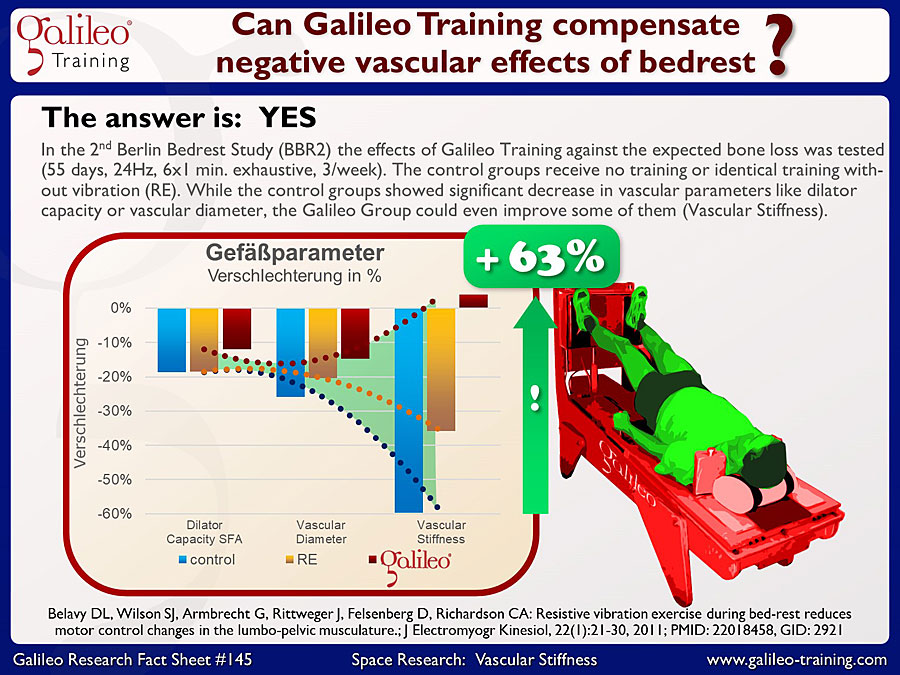
Galileo Research Facts No. 145: Can Galileo Training compensate negative vascular effects of bedrest?
In the 2nd Berlin Bedrest Study (BBR2) the effects of Galileo Training against the expected bone loss was tested (55 days, 24Hz, 6x1 min. exhaustive, 3/week). The control groups receive no training or identical training with-out vibration (RE). While the control groups showed significant decrease in vascular parameters like dilator capacity or vascular diameter, the Galileo Group could even improve some of them (Vascular Stiffness)...
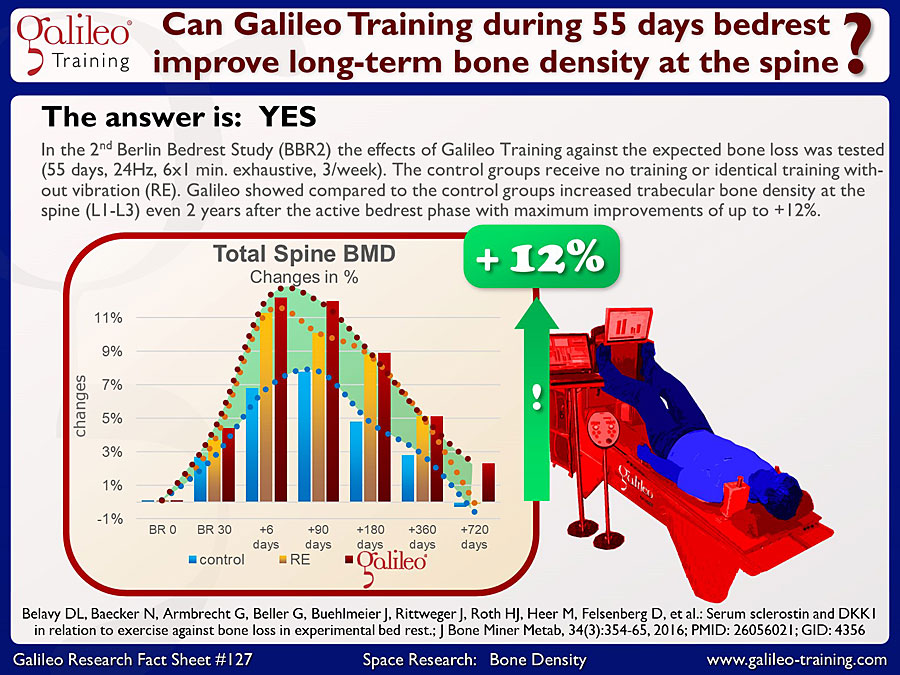
Galileo Research Facts No. 127: Can Galileo Training during 55 days bedrest improve long-term bone mass at the spine?
In the 2nd Berlin Bedrest Study (BBR2) the effects of Galileo Training against the expected bone loss was tested (55 days, 24Hz, 6x1 min. exhaustive, 3/week). The control groups receive no training or identical training with-out vibration (RE). Galileo showed compared to the control groups increased trabecular bone density at the spine (L1-L3) even 2 years after the active bedrest phase with maximum improvements of up to +12%...
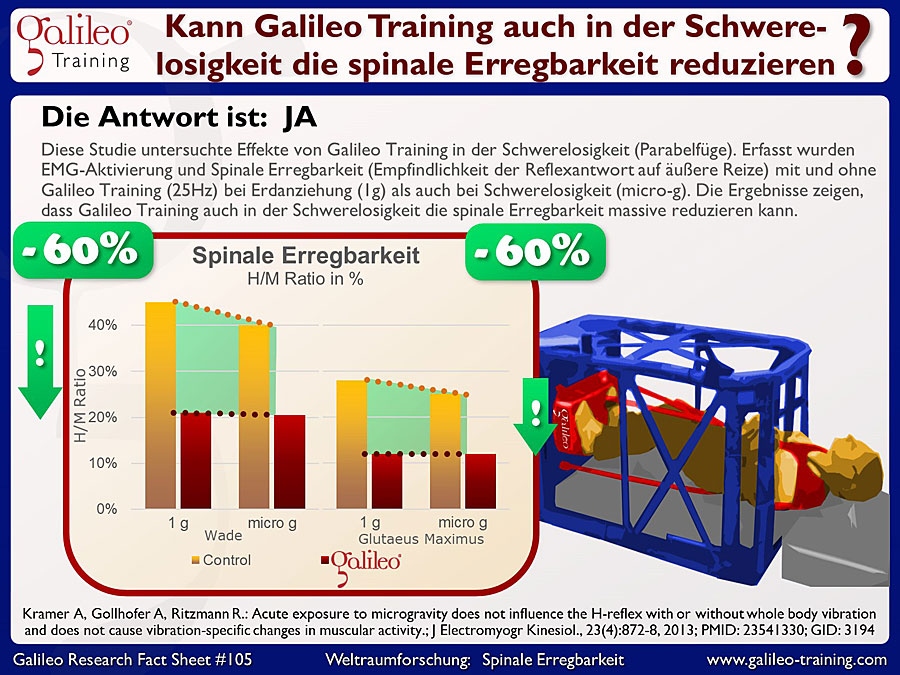
Galileo Research Facts No. 105: Can Galileo Training decrease Spinal Excitability even in micro-gravity?
This study tested the effects of Galileo Training in micro-gravity conditions (parabolic flights). The muscle activation (EMG) and the Spinal Excitability (sensitivity of reflexes reacting on an external stimulus) was assessed with and without Galileo Training (25Hz) in normal gravity (1g) and micro-gravity (micro g). The results prove that Galileo Training can significantly decrease Spinal Excitability even in micro-gravity...
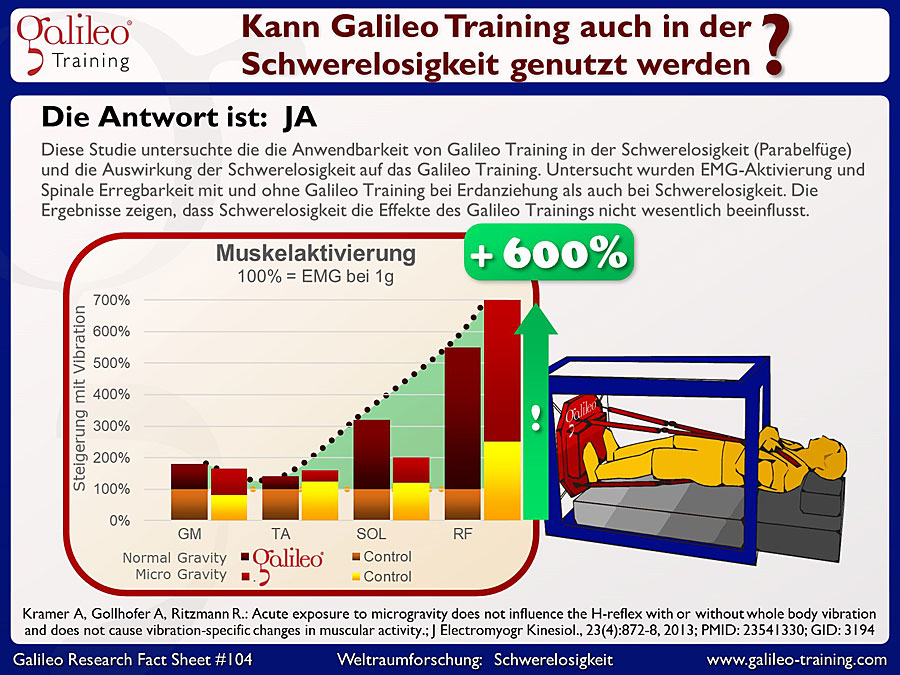
Galileo Research Facts No. 104: Can Galileo Training be used in space?
This study tested the feasibility of Galileo Training in micro-gravity conditions as well as the effects on Microgravity on Galileo Training effects. The EMG activity was assessed with and without Galileo Training in Combination with normal gravity as well as micro gravity. The results show that the effects of Galileo Training on EMG activation is not significantly altered by micro-gravity and that Galileo is feasible under micro gravity...
Galileo Research Facts No. 93: Can 5*10 min./week Galileo Training prevent loss of muscle function during 55 days bedrest?
During the 1st Berlin Bedrest Study (BBR) individuals had to stay in bed for 55 days completely. The control group did no training at all, the Galileo group received 10 Min., 5 days/week 12-26Hz of intense Galileo Training while in bed. The Galileo group could prevent loss of muscle function almost completely while the control group lost muscle function by up to 28%...
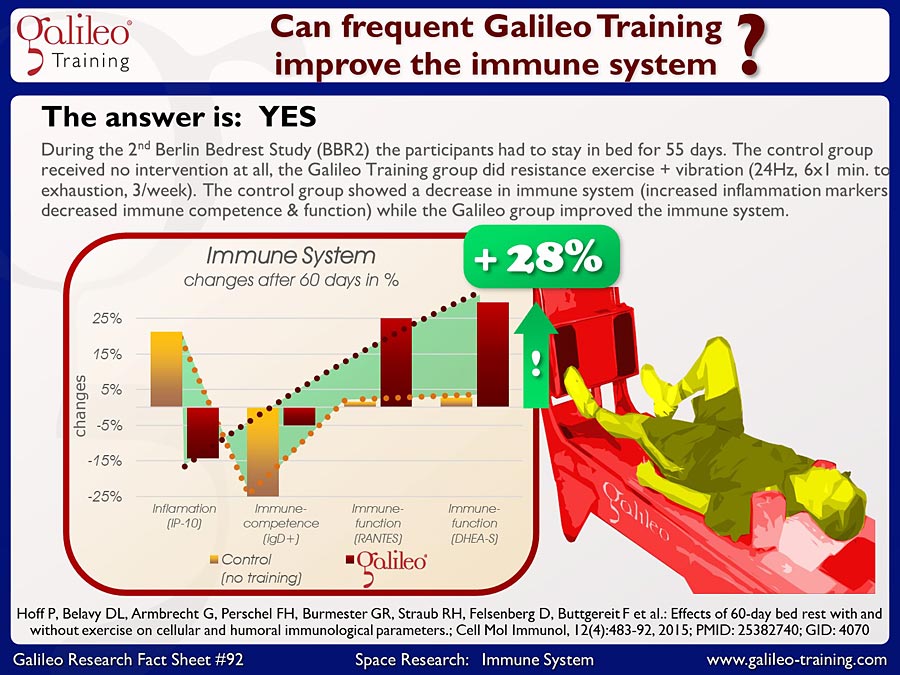
Galileo Research Facts No. 92: Can frequent Galileo Training improve the immune system?
During the 2nd Berlin Bedrest Study (BBR2) the participants had to stay in bed for 55 days. The control group received no intervention at all, the Galileo Training group did resistance exercise + vibration (24Hz, 6x1 min. to exhaustion, 3/week). The control group showed a decrease in immune system (increased inflammation markers decreased immune competence & function) while the Galileo group improved the immune system...

Galileo Research Facts No. 90: Can Galileo Training decrease Creatine Kinase levels during bedrest?
During the 2nd Berlin Bedrest Study (BBR2) the participants had to stay in bed for 55 days. The control group did no training at all, the Galileo group did resistance training + vibration (24Hz, 6x1 min. to exhaustion, 3/week). The Galileo group decreased CK levels to the same values ad the passive control group but received even better training results than the resistance training group which showed the highest CK levels in bedrest...
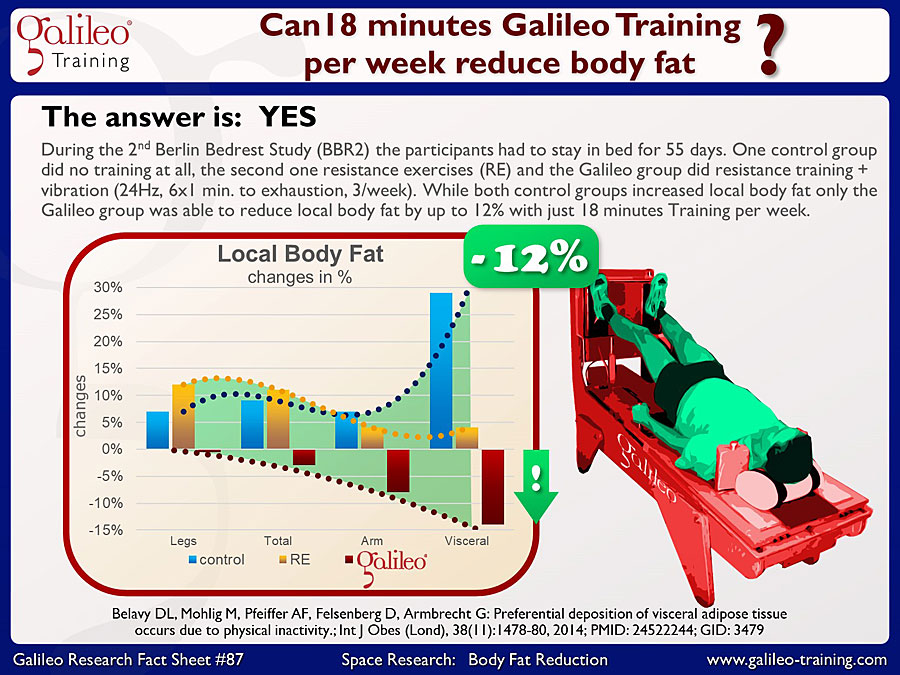
Galileo Research Facts No. 87: Can 18 minutes Galileo Training per week reduce body fat?
During the 2nd Berlin Bedrest Study (BBR2) the participants had to stay in bed for 55 days. One control group did no training at all, the second one resistance exercises (RE) and the Galileo group did resistance training + vibration (24Hz, 6x1 min. to exhaustion, 3/week). While both control groups increased local body fat only the Galileo group was able to reduce local body fat by up to 12% with just 18 minutes Training per week...
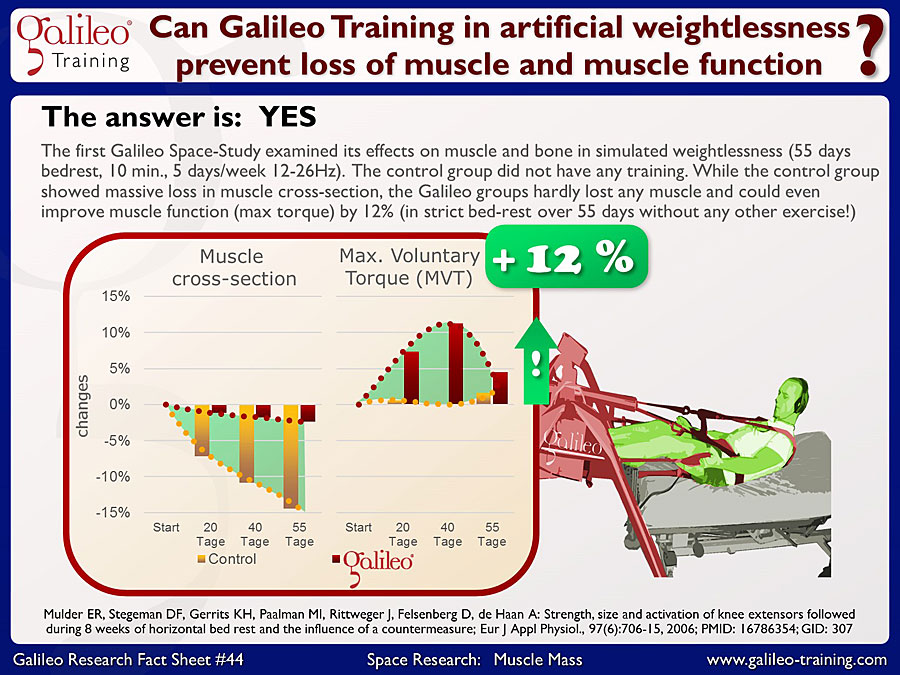
Galileo Research Facts No. 44: Can Galileo Training in artificial weightlessness prevent loss of muscle and muscle function?
The first Galileo Space-Study examined its effects on muscle and bone in simulated weightlessness (55 days bedrest, 10 min., 5 days/week 12-26Hz). The control group did not have any training. While the control group showed massive loss in muscle cross-section, the Galileo groups hardly lost any muscle and could even improve muscle function (max torque) by 12% (in strict bed-rest over 55 days without any other exercise!)...