


GRFS
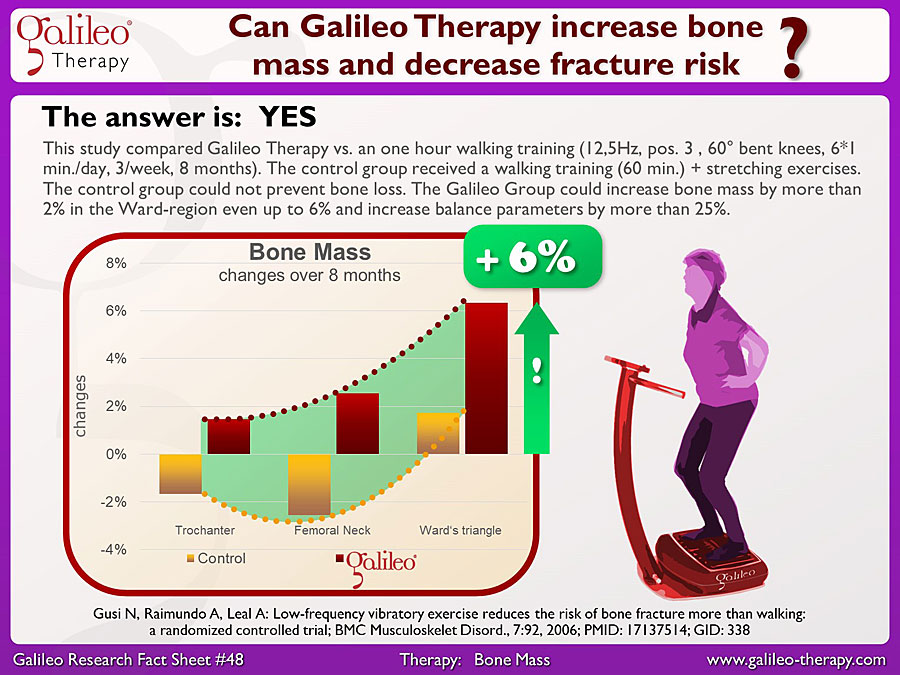
Galileo Research Facts No. 48: Can Galileo Therapy increase bone mass and decrease fracture risk?
This study compared Galileo Therapy vs. an one hour walking training (12,5Hz, pos. 3 , 60° bent knees, 6*1 min./day, 3/week, 8 months). The control group received a walking training (60 min.) + stretching exercises. The control group could not prevent bone loss. The Galileo Group could increase bone mass by more than 2% in the Ward-region even up to 6% and increase balance parameters by more than 25%...
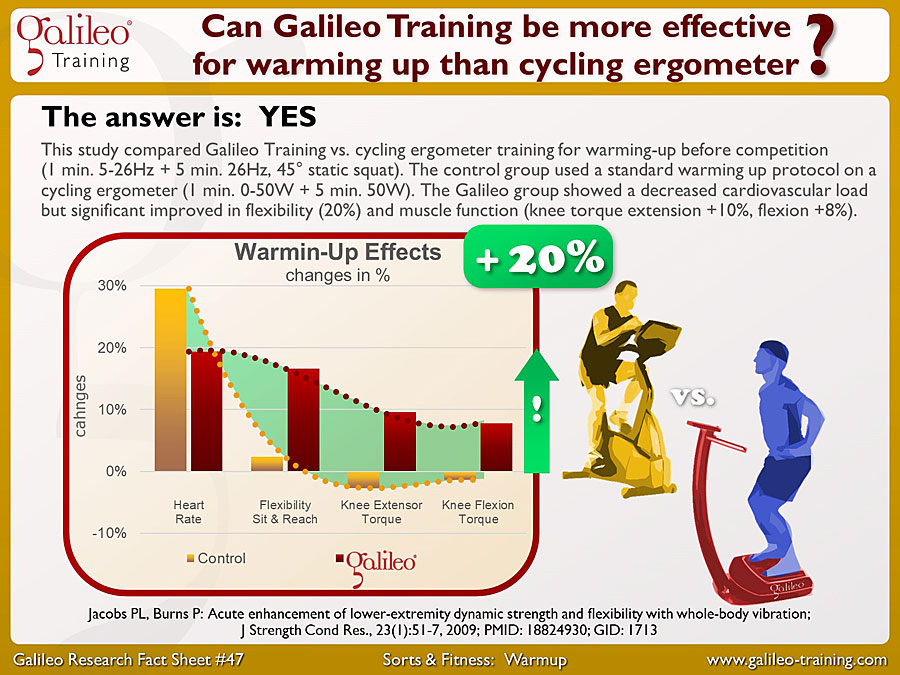
Galileo Research Facts No. 47: Can Galileo Training be more effective for warming up than cycling ergometer?
This study compared Galileo Training vs. cycling ergometer training for warming-up before competition (1 min. 5-26Hz + 5 min. 26Hz, 45° static squat). The control group used a standard warming up protocol on a cycling ergometer (1 min. 0-50W + 5 min. 50W). The Galileo group showed a decreased cardiovascular load but significant improved in flexibility (20%) and muscle function (knee torque extension +10%, flexion +8%)...
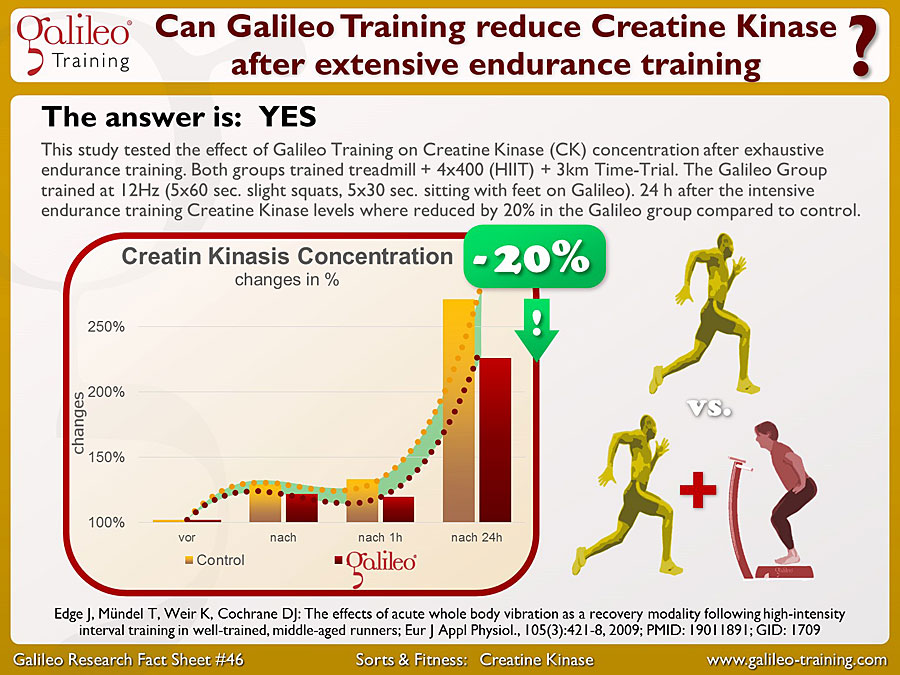
Galileo Research Facts No. 46: Can Galileo Training reduce Creatin Kinase after extensive endurance Training?
This study tested the effect of Galileo Training on Creatine Kinase (CK) concentration after exhaustive endurance training. Both groups trained treadmill + 4x400 (HIIT) + 3km Time-Trial. The Galileo Group trained at 12Hz (5x60 sec. slight squats, 5x30 sec. sitting with feet on Galileo). 24 h after the intensive endurance training Creatine Kinase levels where reduced by 20% in the Galileo group compared to control...
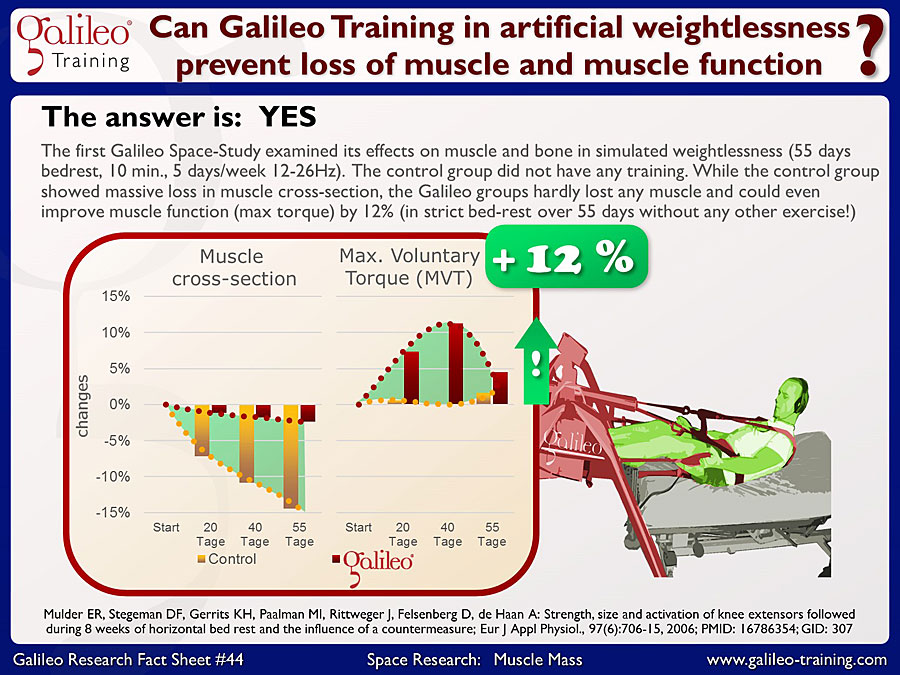
Galileo Research Facts No. 44: Can Galileo Training in artificial weightlessness prevent loss of muscle and muscle function?
The first Galileo Space-Study examined its effects on muscle and bone in simulated weightlessness (55 days bedrest, 10 min., 5 days/week 12-26Hz). The control group did not have any training. While the control group showed massive loss in muscle cross-section, the Galileo groups hardly lost any muscle and could even improve muscle function (max torque) by 12% (in strict bed-rest over 55 days without any other exercise!)...
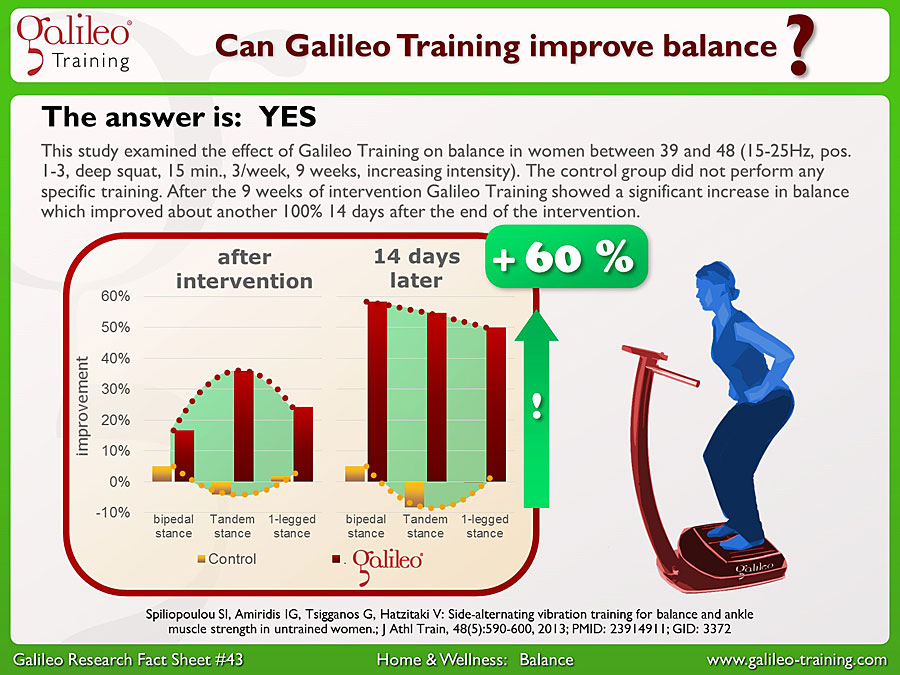
Galileo Research Facts No. 43: Can Galileo Training improve balance?
This study examined the effect of Galileo Training on balance in women between 39 and 48 (15-25Hz, pos. 1-3, deep squat, 15 min., 3/week, 9 weeks, increasing intensity). The control group did not perform any specific training. After the 9 weeks of intervention Galileo Training showed a significant increase in balance which improved about another 100% 14 days after the end of the intervention...
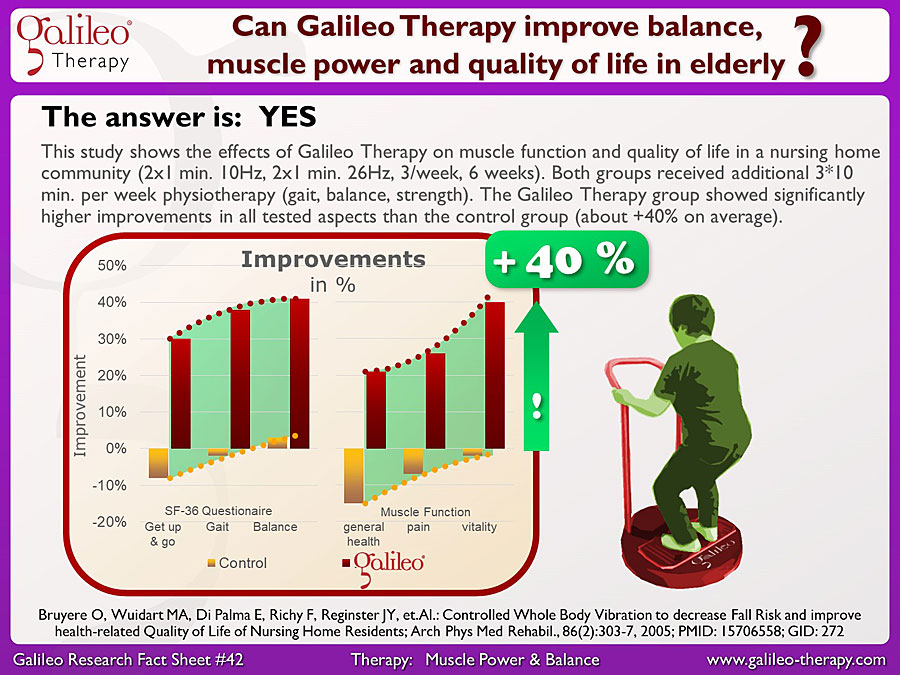
Galileo Research Facts No. 42: Can Galileo Therapy improve balance, muscle power and quality of life in elderly?
This study shows the effects of Galileo Therapy on muscle function and quality of life in a nursing home community (2x1 min. 10Hz, 2x1 min. 26Hz, 3/week, 6 weeks). Both groups received additional 3*10 min. per week physiotherapy (gait, balance, strength). The Galileo Therapy group showed significantly higher improvements in all tested aspects than the control group (about +40% on average).
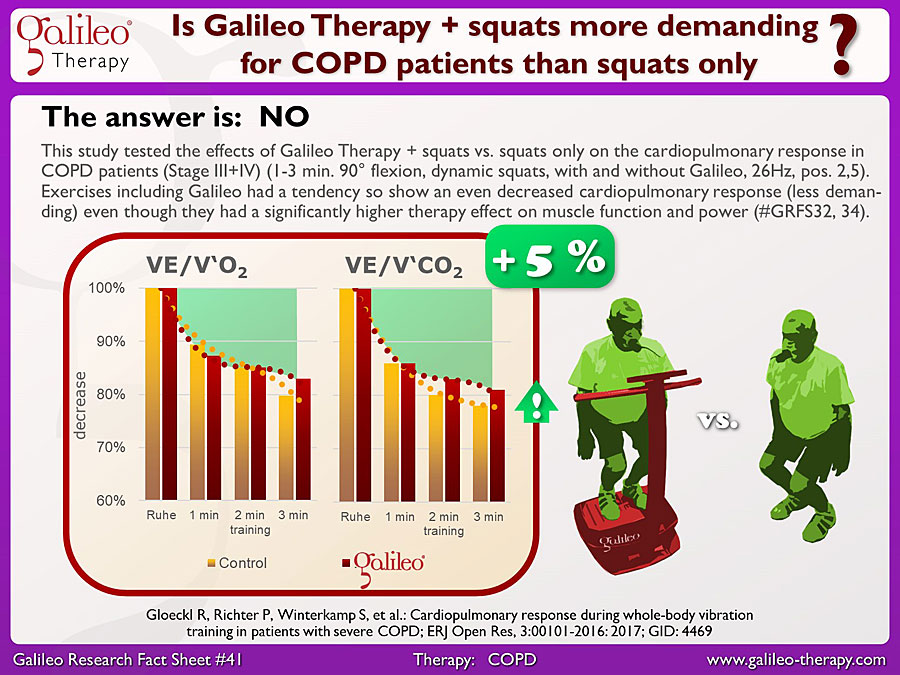
Galileo Research Facts No. 41: Is Galileo Therapy + squats more demanding for COPD patients than squats only?
This study tested the effects of Galileo Therapy + squats vs. squats only on the cardiopulmonary response in COPD patients (Stage III+IV) (1-3 min. 90° flexion, dynamic squats, with and without Galileo, 26Hz, pos. 2,5). Exercises including Galileo had a tendency so show an even decreased cardiopulmonary response (less deman-ding) even though they had a significantly higher therapy effect on muscle function and power (#GRFS32, 34)...
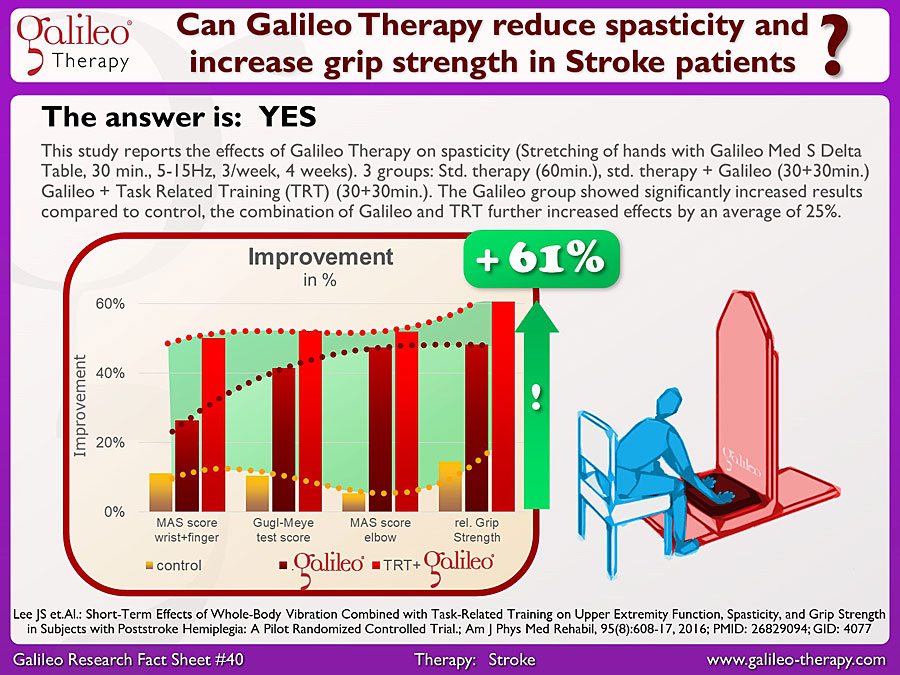
Galileo Research Facts No. 40: Can Galileo Therapy reduce spasticity and increase grip strength in Stroke patients?
This study reports the effects of Galileo Therapy on spasticity (Stretching of hands with Galileo Med S Delta Table, 30 min., 5-15Hz, 3/week, 4 weeks). 3 groups: Std. therapy (60min.), std. therapy + Galileo (30+30min.) Galileo + Task Related Training (TRT) (30+30min.). The Galileo group showed significantly increased results compared to control, the combination of Galileo and TRT further increased effects by an average of 25%...
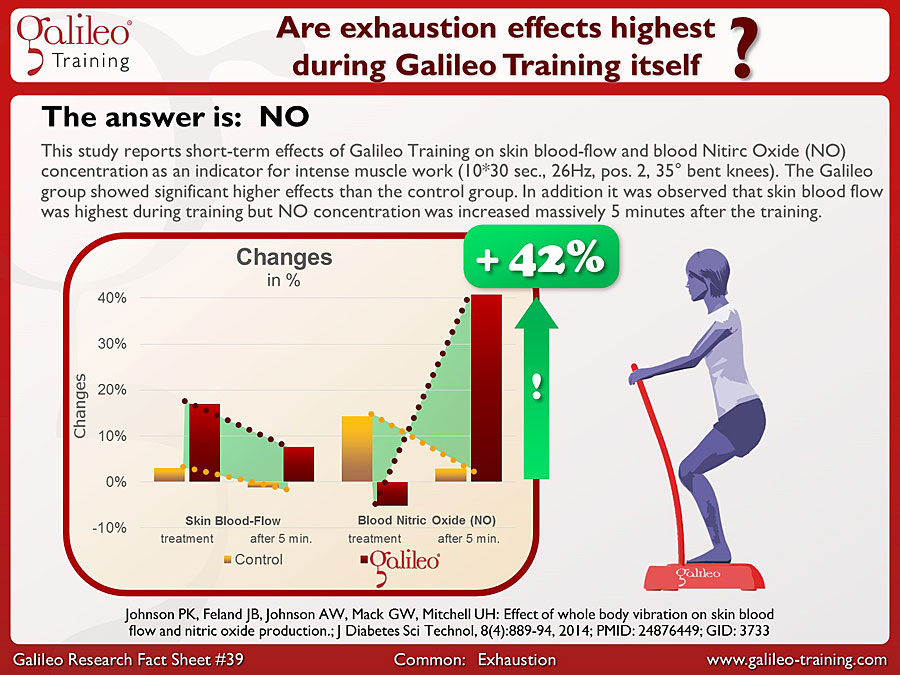
Galileo Research Facts No. 39: Are exhaustion effects highest during Galileo Training itself?
This study reports short-term effects of Galileo Training on skin blood-flow and blood Nitirc Oxide (NO) concentration as an indicator for intense muscle work (10*30 sec., 26Hz, pos. 2, 35° bent knees). The Galileo group showed significant higher effects than the control group. In addition it was observed that skin blood flow was highest during training but NO concentration was increased massively 5 minutes after the training...
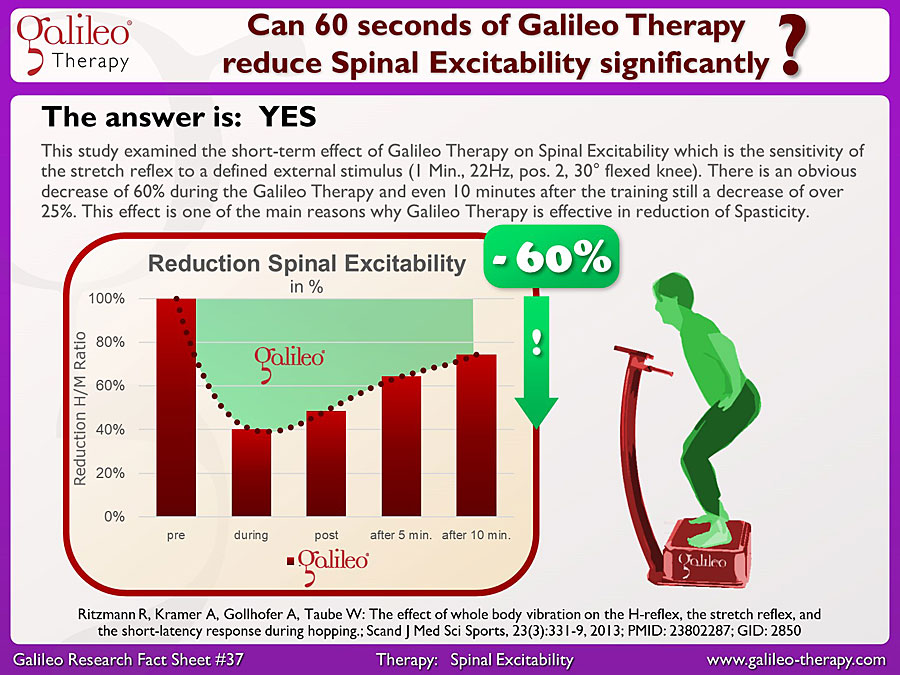
Galileo Research Facts No. 37: Can 60 seconds of Galileo Therapy reduce Spinal Excitability significantly?
This study examined the short-term effect of Galileo Therapy on Spinal Excitability which is the sensitivity of the stretch reflex to a defined external stimulus (1 Min., 22Hz, pos. 2, 30° flexed knee). There is an obvious decrease of 60% during the Galileo Therapy and even 10 minutes after the training still a decrease of over 25%. This effect is one of the main reasons why Galileo Therapy is effective in reduction of Spasticity...